Artificial intelligence is evolving beyond simple question-and-answer interactions. Today, AI systems can plan, act, use tools, and even collaborate with one another to accomplish goals that would have required entire human teams just a few years ago. At the heart of this shift are two closely related concepts: AI agents and multi-agent systems. Understanding these concepts is no longer reserved for researchers or engineers , It is becoming essential knowledge for any business leader, product builder, or legal professional looking to harness the full power of modern AI.
An AI agent is a software system that perceives its environment, makes decisions, and takes actions autonomously to achieve a specific goal , all without requiring a human to approve every step. Unlike a traditional AI chatbot that simply responds to a question, an agent can: • Plan multi-step tasks: Break a large goal into sub-tasks and execute them in the right sequence. • Use external tools: Call APIs, search the web, write and run code, or read and write files. • Adapt in real time: Observe results, handle errors, and revise its plan on the fly. • Maintain memory: Remember context across steps , or even across sessions , to stay coherent. Think of an AI agent as an autonomous employee who has been given a goal, a set of tools, and the authority to figure out the best path forward. "An agent is not just an AI that answers , it is an AI that acts."
Every AI agent is built around five fundamental components: • LLM Brain: A large language model that serves as the reasoning engine , understanding goals, crafting plans, and interpreting results. • Memory: Short-term (context window) and long-term (databases or vector stores) memory that allows the agent to retain information. • Tools: External capabilities the agent can invoke , web search, code execution, document reading, API calls, or sending emails. • Planning & Reasoning: The ability to decompose complex tasks, reason about options, and choose the best course of action. • Action Loop: A perceive → think → act cycle that runs iteratively until the goal is achieved or a human is needed.
A multi-agent system (MAS) is a network of individual AI agents that collaborate , and sometimes compete , to solve tasks that are too large, too complex, or too specialized for a single agent to handle alone. Just as a high-performing company organizes specialized teams (legal, finance, engineering, marketing) that work in parallel on a shared goal, a multi-agent system assigns specialized agents to different subtasks, enabling them to work concurrently and hand off results to one another. "Multi-agent systems don't just make AI more powerful , they make AI more organizational."
• Hierarchical: An orchestrator agent delegates tasks to specialized sub-agents and collects their outputs. • Peer-to-Peer: Agents communicate directly, sharing information without a central coordinator. • Pipeline: Output from one agent feeds as input to the next, forming an assembly line of tasks. • Debate / Review: Multiple agents propose solutions; others critique and refine until consensus or quality is reached.
Choosing between a single agent and a multi-agent system depends on the complexity and parallelism of the task: • Use a single agent for focused, linear tasks: summarizing a document, classifying emails, drafting a clause. • Use a multi-agent system for complex, parallel, or end-to-end workflows: full contract review, software development pipelines, financial research spanning multiple markets. Multi-agent systems shine when tasks benefit from parallelism (speed), specialization (accuracy), or redundancy (fault tolerance). The tradeoff is higher complexity and cost, which is justified for high-stakes or high-volume workflows.
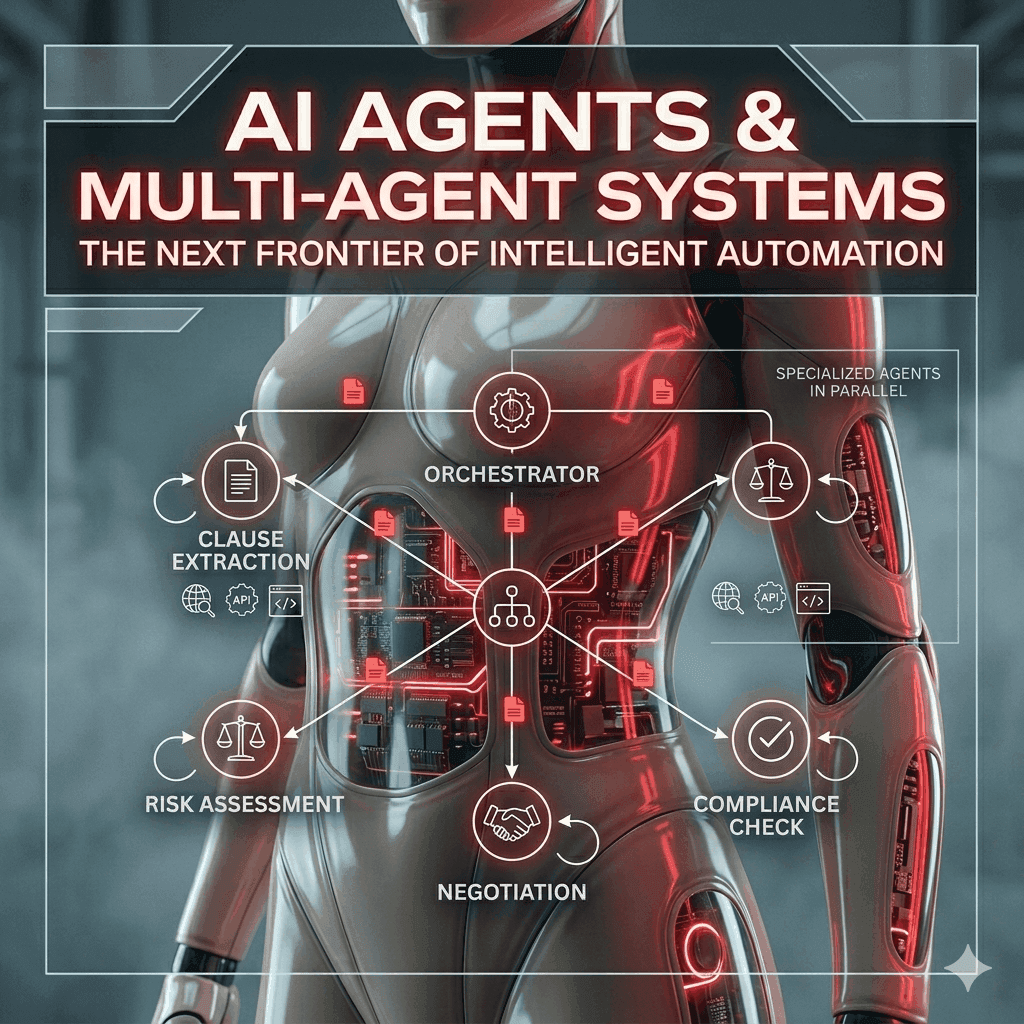
Legal & Contract Intelligence In legal operations, multi-agent systems unlock capabilities that single models cannot match. A legal AI pipeline might include a clause extraction agent, a risk assessment agent, a negotiation suggestions agent, and a compliance checker agent , all orchestrated to review a contract end-to-end in minutes rather than hours. This is exactly the kind of intelligent workflow ContractZLab is building toward. Software Development Coding agents can write code, run tests, fix bugs, and open pull requests , automatically. Multi-agent setups go further: one agent writes code while another reviews it, and a third handles documentation, all in parallel. Financial Research & Analysis Agents can autonomously gather data from multiple sources, run analyses, and generate reports. Multi-agent architectures allow simultaneous research across markets, asset classes, or geographies , compressing days of analyst work into minutes. Customer Operations Customer-facing agents handle tier-1 support, escalate intelligently, trigger backend workflows, and learn from every interaction. Multi-agent systems route complex cases to specialized agents without human dispatchers.
As powerful as agents are, deploying them responsibly requires awareness of several challenges: • Hallucination & Errors: Agents can make mistakes and , without proper guardrails , propagate them through a pipeline. Human-in-the-loop checkpoints remain critical for high-stakes decisions. • Security & Prompt Injection: Agents that consume external content can be manipulated by malicious inputs. Sandboxing and input validation are essential. • Cost Management: Multi-agent systems can consume significant compute resources. Careful task routing and model selection is key to controlling costs. • Observability: Understanding what a network of agents actually did , and why , requires robust logging, tracing, and monitoring infrastructure. • Governance & Accountability: In regulated industries like law and finance, knowing which agent made which decision , and being able to audit it , is not optional. It is a compliance requirement.
We are at the beginning of a profound shift. The first wave of enterprise AI was about augmentation , helping humans work faster. The second wave, driven by agents and multi-agent systems, is about delegation , allowing AI to take ownership of entire workflows. Forward-looking organizations are already asking not "how do we use AI to assist our team?" but "which processes can we build an agent team around?" The enterprises that answer this question well , and build the governance frameworks to do it safely , will have a substantial competitive edge in the coming decade. At ContractZLab, we believe that intelligent contract workflows powered by agentic AI represent one of the most high-impact near-term opportunities for legal and operations teams. We are building toward a future where contract review, risk assessment, and negotiation are not tasks that consume human hours , they are workflows that run autonomously, with humans focused on strategy and judgment rather than repetitive analysis. "The question is no longer whether agents will transform your industry. It is whether you will be the one building them , or the one disrupted by them."