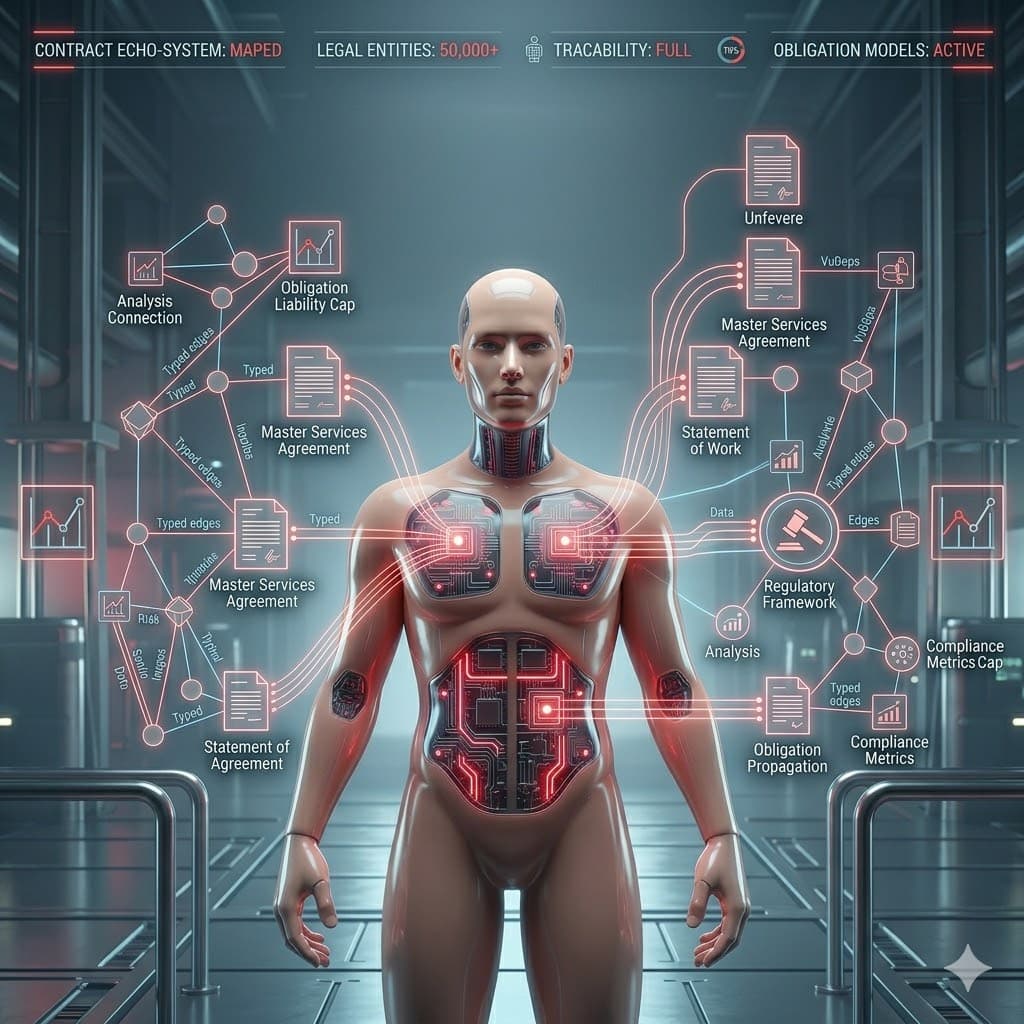
For decades, legal technology has evolved in successive layers. First came document digitization, converting paper-based contracts into searchable digital assets. Then came keyword search and document management systems, improving accessibility but still relying entirely on human interpretation. More recently, AI-powered systems based on Retrieval-Augmented Generation (RAG) introduced automation, enabling machines to retrieve, summarize, and answer questions over legal content. Yet all these paradigms share a structural limitation: they treat contracts as isolated documents. In practice, legal systems operate very differently. A Master Services Agreement references a Statement of Work. That SOW depends on a Data Processing Addendum. That DPA is itself anchored in a regulatory framework that evolves continuously. Contracts form a dynamic system of interdependent obligations, relationships, and regulatory constraints , not a collection of independent files. This is where traditional AI reaches its limits. And this is where a new paradigm emerges: GraphRAG.
Most legal AI solutions today rely on Retrieval-Augmented Generation (RAG): • documents are decomposed into text fragments • indexed using semantic embeddings • retrieved based on similarity search This architecture performs well for: • clause extraction • contract summarization • isolated question answering However, it breaks down when legal reasoning requires system-level understanding. As soon as queries involve cross-contract dependencies, obligation propagation, regulatory impact analysis, or temporal evolution of clauses , RAG reaches its limits. It retrieves relevant fragments, but it cannot model or traverse legal relationships.
Contractzlab introduces a fundamentally different approach: GraphRAG-powered legal intelligence. Instead of modeling contracts as flat text, Contractzlab represents them as a structured and interconnected legal system. At its core: • legal entities (parties, clauses, obligations, dates, regulatory references) are modeled as nodes • legal relationships (dependencies, conditions, overrides, references) are modeled as typed edges • the entire contract ecosystem becomes a queryable knowledge graph This transforms how legal queries are processed. A question such as "What are Vendor X's liability caps across all active agreements?" is no longer treated as a semantic search problem , it becomes a graph traversal operation, enabling exhaustive coverage across all relevant contracts, precise aggregation of obligations, and full traceability of sources and dependencies.
Contractzlab's GraphRAG implementation is built on a multi-layered architecture designed for enterprise-grade scalability, explainability, and integration. 1. Advanced Document Ingestion & Normalization • multi-format support (PDF, Word, Excel, scanned documents) • OCR pipelines for unstructured inputs • structural parsing (sections, clauses, annexes) • semantic segmentation beyond linear chunking 2. Legal-Specific Information Extraction • proprietary AI models trained on domain-specific legal corpora • extraction of named entities, clause typologies, obligations, rights, and conditional logic 3. Legal Knowledge Graph Construction • graph-based data modeling (Neo4j-class or equivalent distributed graph systems) • encoding of inter-contract relationships, clause dependencies, regulatory mappings, and amendment lineage 4. Hybrid Retrieval Layer (GraphRAG Core) • vector-based retrieval combined with graph traversal for contextual expansion • dynamic context assembly optimized for latency and completeness 5. Specialized Legal AI Models • proprietary legal LLMs fine-tuned for contract analysis, compliance assessment, and risk scoring • explainable outputs with source traceability, justification paths, and audit-ready reasoning
By combining GraphRAG and domain-specific AI, Contractzlab enables a shift from document management to legal intelligence operations. • Regulatory Change Management: Automatically identify all contracts and clauses impacted by regulatory updates, with direct mapping to internal policies and procedures. • Counterparty Risk & Due Diligence: Instantly aggregate exposure across all agreements involving a specific vendor or partner. • Contract Risk Analytics: Detect inconsistencies, hidden liabilities, and risk concentrations across contract portfolios. • Amendment Genealogy & Auditability: Track how obligations evolve across versions and negotiations, with full historical traceability.
GraphRAG is not designed to replace legal professionals. It is designed to provide them with system-level visibility and decision support. Contractzlab acts as an intelligence infrastructure layer that enables legal and compliance teams to: • access complete and contextualized information instantly • reduce manual analysis time by orders of magnitude • improve consistency and auditability of decisions The system structures and accelerates legal reasoning. Human expertise remains central to validation and decision-making.
While many solutions remain focused on document-level automation, Contractzlab is building a system-level intelligence platform for contracts and regulatory compliance. By combining GraphRAG architectures, proprietary legal AI models, workflow orchestration across business processes, and enterprise-grade integrations (banking, insurance, large corporates), Contractzlab positions itself not as a tool, but as core infrastructure for legal and compliance operations.
The future of contract management is no longer about retrieving clauses faster. It is about understanding how entire systems of obligations, risks, and regulations interact in real time. GraphRAG provides the foundation for this shift. Contractzlab is already operationalizing it at scale.